Abstract
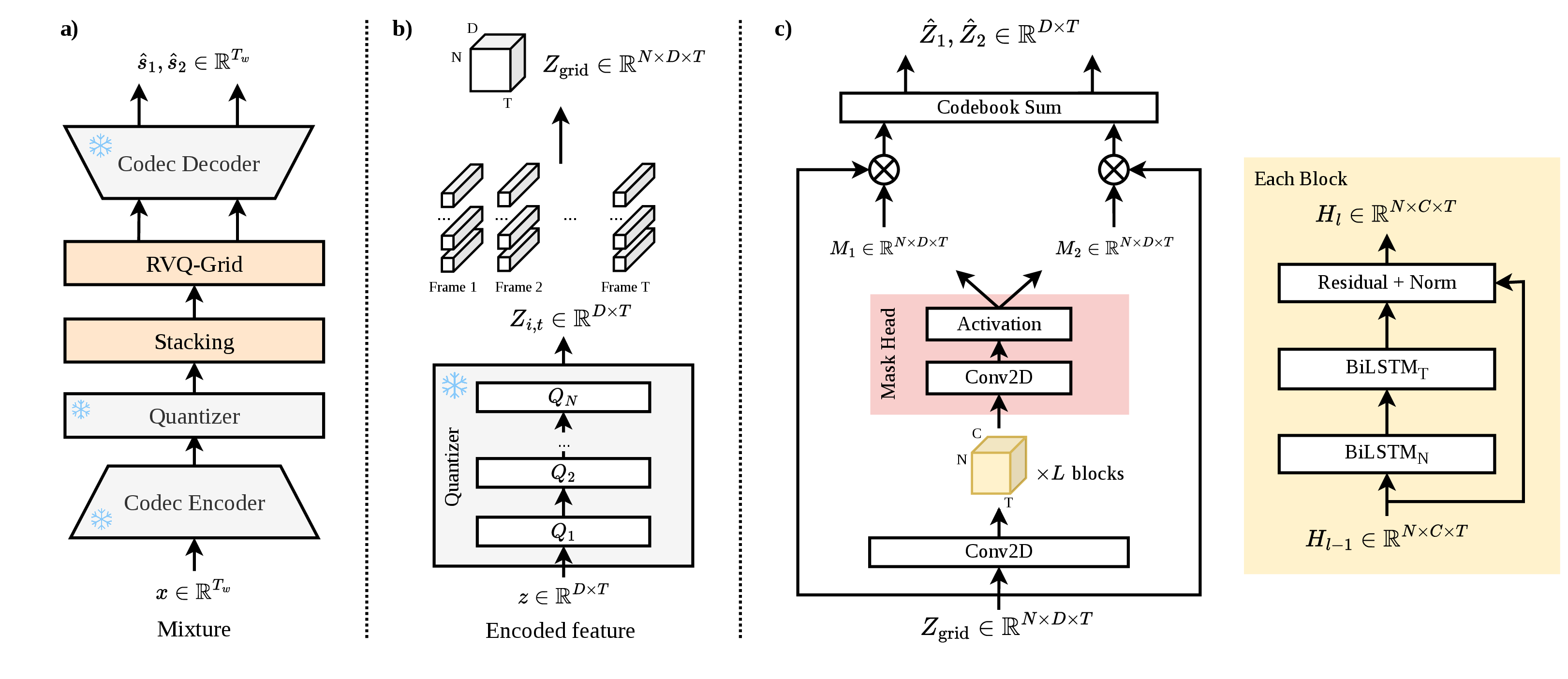
Speech separation models trained on raw waveforms achieve high performance but come with substantial computational costs. Neural Audio Codecs (NACs) offer an efficient alternative by operating in compressed latent spaces. However, the existing codec-based method aggregates per-layer Residual Vector Quantization (RVQ) vectors into a single vector, collapsing the coarse-to-fine acoustic hierarchy. We propose RVQ-Grid to explicitly preserve this hierarchy by stacking per-layer RVQ vectors into a 3D grid and processing it using dual-axis recurrent blocks. On WSJ0-2Mix, RVQ-Grid achieves a +3.6 dB SI-SDRi improvement over the prior codec-based method. Our evaluation on the Automatic Speech Recognition task shows that RVQ-Grid achieves an 8.6% WER, demonstrating comparable performance to the SepFormer baseline under the same codec condition. During inference, RVQ-Grid achieves a 6x reduction in MACs compared to SepFormer.
Audio Samples
Qualitative speech separation results on the WSJ0-2Mix test set. Sample are selected randomly.
BibTeX
To be added.